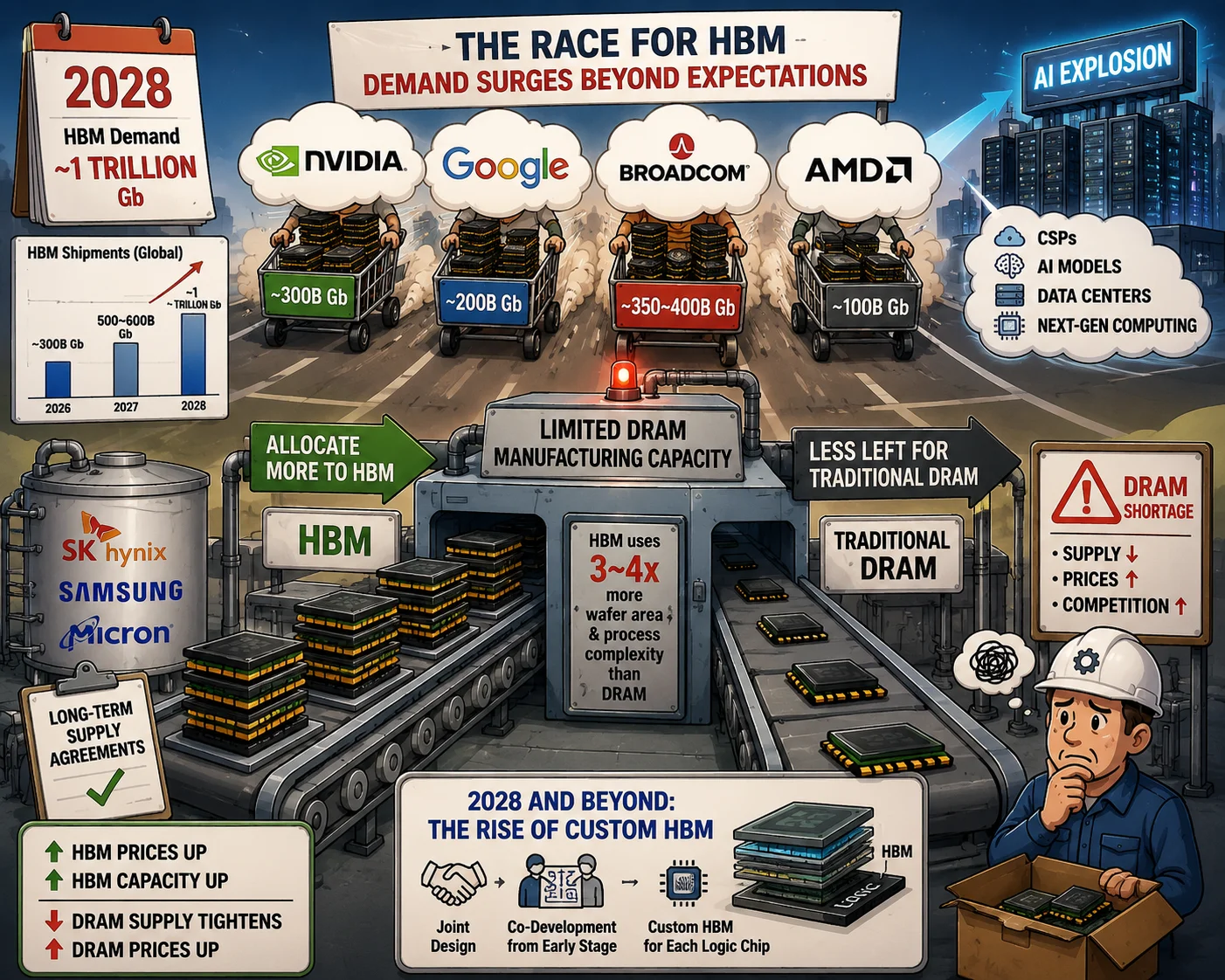
Mirz Securities: the race for HBM could create a severe DRAM shortage in 2027–2028
$MU / $SKHY / $DRAM/ $NVDA / $AMD / $AVGO / $GOOGL
Summary and analysis by Mirz Securities, Semiconductor and Display Division, Kim Sun-woo
The memory market is entering a period that could be very significant for the chip industry, not only due to the increase in HBM demand, but because of the impact of this demand on traditional DRAM.
According to Mirz Securities' channel checks, signs are already beginning to emerge that the memory shortage will not be a short-term event, but could become a structural problem in 2027–2028.
The most important point is simple: to produce more HBM, memory manufacturers need to allocate more production resources, space, and manufacturing capacity, and some of this capacity comes from the same infrastructure used to produce regular DRAM.
Therefore, as HBM demand grows, a situation could arise where more HBM means less traditional DRAM, even if DRAM demand itself continues to grow.
HBM demand is starting to exceed existing forecasts
In the past month, there have been quite a few concerns in the market regarding the memory cycle, but according to Mirz Securities, signs of a long-term shortage are becoming clearer.
The company reports a significant increase in customer inquiries for supply confirmation of advanced memory products, especially HBM, until 2028.
This is important data, because large cloud companies, AI chip manufacturers, and model developers are currently finalizing their future investment plans.
Once companies approve investment plans, they also need to secure the components without which the systems cannot operate.
HBM is one of those components.
It serves as ultra-fast memory connected to AI accelerators, and it allows for the transfer of vast amounts of information between the processor or accelerator and the memory.
As models become larger and more complex, and as data centers operate more AI accelerators simultaneously, the demand for HBM increases rapidly.
The numbers for 2028 are starting to be exceptional
According to Mirz Securities' channel checks, as of August, the demand plans of several key customers for HBM in 2028 have been significantly updated upwards.
The estimates include:
- Broadcom, approximately 350–400 billion Gb
- Nvidia, approximately 300 billion Gb
- Google, approximately 200 billion Gb
- AMD, approximately 100 billion Gb
In other words, these four companies alone generate a potential demand of approximately 950 billion Gb, and in Broadcom's high-end scenario, even around one trillion Gb.
Here a very interesting gap emerges.
Mirz Securities notes that estimates from entities like Gartner currently place the entire HBM market in 2028 at around 550 billion Gb.
If customer demand plans indeed materialize, this represents a very significant gap between current market size forecasts and the demand that customers themselves are starting to present.
This may indicate that the market is still undergoing rapid updates, and existing forecasts may not reflect the true growth rate of AI infrastructure.
The big problem is not just HBM, but the capacity behind it
To understand the risk, one needs to understand the difference between regular DRAM and HBM.
HBM is not simply "faster DRAM."
It is a complex structure where multiple layers of memory are stacked on top of each other and connected very densely.
This allows for much higher bandwidth, but also increases manufacturing complexity.
This means that HBM production requires more chip area, more production steps, more packaging and testing processes, and also dealing with manufacturing success rates.
According to Mirz Securities, the ratio between regular DRAM production and HBM can reach approximately 3:1 to 4:1, depending on the chip size and the complexity of the production process.
In simple terms, the same production capacity that can be used to produce a large quantity of regular DRAM can produce a much smaller quantity of HBM.
And this makes the decision for memory manufacturers very complex.
What happens if manufacturers shift capacity to HBM?
Suppose a memory manufacturer has a limited production line.
It can use it to produce regular DRAM, or shift part of the capacity to HBM production.
If HBM demand rises sharply, it has an economic incentive to shift more capacity to HBM, especially if customers are willing to pay a higher price and sign long-term contracts.
But then a reverse effect occurs in the DRAM market.
Less capacity available for DRAM → less supply → shortage → price increase.
Therefore, the race for HBM could become a problem for the traditional DRAM market.
Mirz Securities estimates that if memory manufacturers start, as early as the end of the year, to convert regular DRAM production lines to HBM at a significant pace, the effective production of regular DRAM could be significantly impacted.
And this is happening precisely when DRAM demand itself is also growing, due to servers, data centers, computers, and AI applications.
The gap between 2026, 2027, and 2028 becomes very important
According to the data presented by Mirz Securities:
Global HBM shipments in 2026 are expected to be slightly above 300 billion Gb.
In 2027, shipments are expected to rise to approximately 500–600 billion Gb.
But in 2028, demand plans coming from customers are already approaching one trillion Gb.
In other words, within about two years, the market is required to almost double the supply volume again.
And this is precisely where the physical problem begins.
To double HBM shipments, it's not enough to simply "run existing factories a bit more."
Since HBM consumes much more production capacity relative to regular DRAM, a very significant expansion of the production infrastructure is required.
According to Mirz Securities, to enable a doubling of HBM shipments annually, a 5–6 fold increase in traditional DRAM production capacity is required, based on a space consumption ratio of approximately 3:1.
The problem is that a physical expansion of this magnitude is not realistic within a short period.
It's not possible to simply add several new factories within a year, acquire all the necessary equipment, train it, and reach full production.
Therefore, if demand indeed materializes, part of the adjustment will have to come through prices.
Therefore, HBM may become more expensive, and after it, DRAM as well
When a product is in short supply, its price usually starts to reflect the shortage.
In HBM, the situation is even more interesting, because it is a critical product for companies operating AI infrastructures costing billions of dollars.
If a company has invested billions in a data center but cannot obtain enough HBM, the cost of memory becomes less important compared to the cost of being unable to operate the infrastructure.
Therefore, memory manufacturers have significant bargaining power.
Mirz Securities estimates that suppliers may promote:
1. HBM price increases
Including the possibility of price updates even in existing contracts.
2. Increased investments in HBM
More production lines and future capacity will be directed to HBM.
3. A slowdown in the growth rate of regular DRAM
And this is the part that could surprise the market.
Even if DRAM demand continues to grow, supply may not grow at the same pace.
The result could be a continuous shortage and price increases.
The competition for HBM becomes a competition for capacity
This means that in 2027–2028, the competition will not only be between Nvidia and AMD, or between cloud providers.
The competition will also be for the capacity of memory manufacturers.
Nvidia needs HBM for its AI systems.
CSP companies, meaning large cloud service providers, need HBM for their data centers.
Google needs HBM for its AI infrastructure.
Companies like Broadcom and AMD need HBM for AI chips and custom systems.
At the same time, companies developing advanced models also need increasing computing power.
Everyone is competing for the same resource.
Therefore, an increase in requests from American companies for long-term supply commitments can already be seen.
Why do cloud companies want to secure HBM now?
The answer is related to how data centers are built.
Establishing a new data center is not a decision made a month before operation.
These are projects built and planned years in advance.
Companies need to know how much power they will have, how many chips will be available, how many servers they can order, and how much memory will be available.
Therefore, once cloud companies approve an investment plan for 2027 or 2028, they start securing the necessary components now.
From their perspective, a long-term contract with an HBM manufacturer is a type of insurance.
They are willing to pay more to ensure that capacity will be available when the data center begins operation.
Rubin Ultra also highlights the complexity
One of the interesting data points mentioned in the analysis is Nvidia's consideration of a Rubin Ultra configuration with 8 layers of HBM4E, totaling 192GB, instead of a 12-layer configuration, which would have reached approximately 288GB.
There are several possible explanations for this.
As HBM layers are added, the amount of memory increases, but so does the complexity.
More layers mean more connectivity, more power consumption, more heat, and more complex packaging requirements.
Therefore, part of the change could be related to thermal and engineering issues.
But Mirz Securities also sees this as a possible sign that HBM supply itself is becoming a significant consideration in system design.
In other words, the question will not always be:
How much HBM do we want?
But also:
How much HBM can we get?
And this is a significant change in the industry.
From 2028, a new phase arrives, Custom HBM
Mirz Securities also points to another important development: the transition to HBM4E and HBM5 generations in 2028 is expected to accelerate the shift to Custom HBM.
Custom HBM is essentially memory developed to be more tailored to the logic chip it connects to.
Instead of the customer simply buying a standard HBM product, joint work between the memory manufacturer and the logic chip developer is required very early in the design stages.
The reason is that each chip developer can use a different architecture, different requirements, and different computing standards.
If the HBM is not pre-designed according to the logic chip, a situation can arise where the specifications are not fully compatible, making it difficult to switch suppliers and purchase HBM from another source.
Therefore, as Custom HBM expands, the relationship between the memory manufacturer and the customer becomes deeper.
And this also changes the market structure
In regular HBM, the memory manufacturer can be thought of as a supplier that produces a product and sells it to customers.
In Custom HBM, the relationship becomes closer to a technological partnership.
The customer participates in the design.
The memory manufacturer adapts the product.
Both sides need to make early investments.
And when the design is complete and the product enters production, it is harder to quickly switch to another supplier.
Therefore, starting in 2028, the design partnership may directly impact the market share, sales, and profitability of HBM suppliers.
Who might benefit from the situation?
The scenario presented by the data is particularly positive for memory manufacturers that can rapidly increase HBM, but also maintain control over their DRAM capacity.
The main companies to watch are:
SK Hynix, which holds a very strong position in the HBM market,
Samsung Electronics, which is trying to increase its market share in HBM and expand production,
and Micron, which has also become a key player in the HBM field and is directly affected by demand from AI infrastructure.
For manufacturers, the ideal scenario is not just to sell more HBM.
If the DRAM shortage expands simultaneously, they can benefit from price increases in both markets.
But here also lies the risk
It should be remembered that everything depends on AI demand continuing to grow at the current pace.
If cloud companies slow down their investment plans, if demand for AI accelerators moderates, or if model efficiency significantly improves and reduces the need for vast amounts of hardware, HBM demand forecasts could change.
In addition, memory manufacturers can increase investments and add capacity.
Therefore, it is not certain that there will be a trillion Gb shortage.
But according to Mirz Securities, the early signs that customers themselves are already starting to secure capacity for years ahead are very significant.
The big picture
The HBM story is starting to look less like just another product in the memory market, and more like a central bottleneck in the AI revolution.
AI demand increases demand for GPUs and accelerators.
Accelerators require more HBM.
HBM consumes more production capacity than regular DRAM.
Manufacturers are shifting capacity to HBM.
As a result, less capacity remains for DRAM.
And at the same time, DRAM demand itself continues to grow.
Thus, a situation arises where:
More AI = more HBM = less capacity for DRAM = DRAM shortage = rising memory prices.
And this is precisely why Mirz Securities' analysis is important.
The market may currently be focused on HBM prices and Nvidia's ability to obtain enough memory for next-generation systems, but the bigger problem could be much broader.
The race for HBM could make the entire memory market more expensive and constrained in 2027–2028.
If current demand forecasts materialize, we may see a period where memory manufacturers benefit from a rare combination of strong HBM demand, strong DRAM demand, capacity shortages, higher bargaining power, and long-term contracts with tech giants.
In other words, the next limitation for AI infrastructure may not just be how many accelerators can be produced, but how much memory can be produced for them.